“Love is not the icing on the cake of life. It is a basic primary need, like oxygen or water.”
- Dr. Sue Johnson, Founder of Emotionally Focused Therapy
Emotionally Focused Therapy in Gallatin, TN
Sometimes you can love each other deeply and still find yourselves caught in the same patterns.
Emotionally Focused Therapy (EFT) helps couples slow those patterns down, understand what’s happening underneath them, and find new ways of reaching for and responding to each other.
I also draw from EFT in individual therapy to help people better understand the emotional and relationship patterns that shape how they experience themselves and connect with others.
Emotionally Focused Therapy for Couples
What we know from decades of relationship research—including the work of John and Julie Gottman—is that how couples respond to one another in moments of disconnection matters. EFT takes us underneath those moments to understand the emotions, attachment needs, and patterns that keep couples caught.
Most couples do not come to counseling because they don’t care about each other. They come because they’ve gotten caught in a pattern that keeps pulling them away from each other.
Maybe you keep having the same argument, even when you promised yourselves you wouldn’t. One of you reaches for connection while the other pulls away. Conversations quickly turn into criticism, defensiveness, or shutdown. Or maybe there isn’t much conflict at all—you just don’t feel as close as you used to.
Over time, it can become harder to see the person you love underneath the pattern you’re both caught in.
Emotionally Focused Therapy (EFT) helps us slow that pattern down and understand what’s happening underneath it. Rather than simply working on how to communicate better, we pay attention to what happens between you in the moments when connection gets harder—what you feel, how you protect yourself, what you need, and how your partner experiences you in return.
As couples begin to understand the cycle as the problem rather than each other, there is more room for something different to happen. The goal is not to eliminate every disagreement, but to help you find your way toward each other differently when hard moments come.
Couples Often Come to Me When:
You keep having the same arguments without really resolving them.
One of you tends to pursue while the other shuts down, withdraws, or needs space.
You love each other, but don’t feel as close or connected as you once did.
Communication quickly turns into criticism, defensiveness, or misunderstanding.
You feel more like roommates than partners.
Trust has been shaken by betrayal or an affair.
A major life transition has changed your relationship.
You’re preparing for marriage and want to build a strong foundation.
You know you want something more for your relationship.
What Does an EFT Session Look Like?
EFT is experiential, which means we won’t only talk about what happened during the argument you had Tuesday night. We’ll slow it down enough to understand what was happening for each of you inside that moment.
I may help you notice where the conversation shifted, what you felt before the anger or shutdown showed up, or what you were hoping your partner would understand but had a hard time saying.
Sometimes we’ll even practice saying something differently to your partner right there in the room.
Over time, these new experiences can begin to change what happens between you—helping you reach for each other, respond differently, repair when needed, and stay more connected when things get hard.
The Emotionally Focused Therapy Process
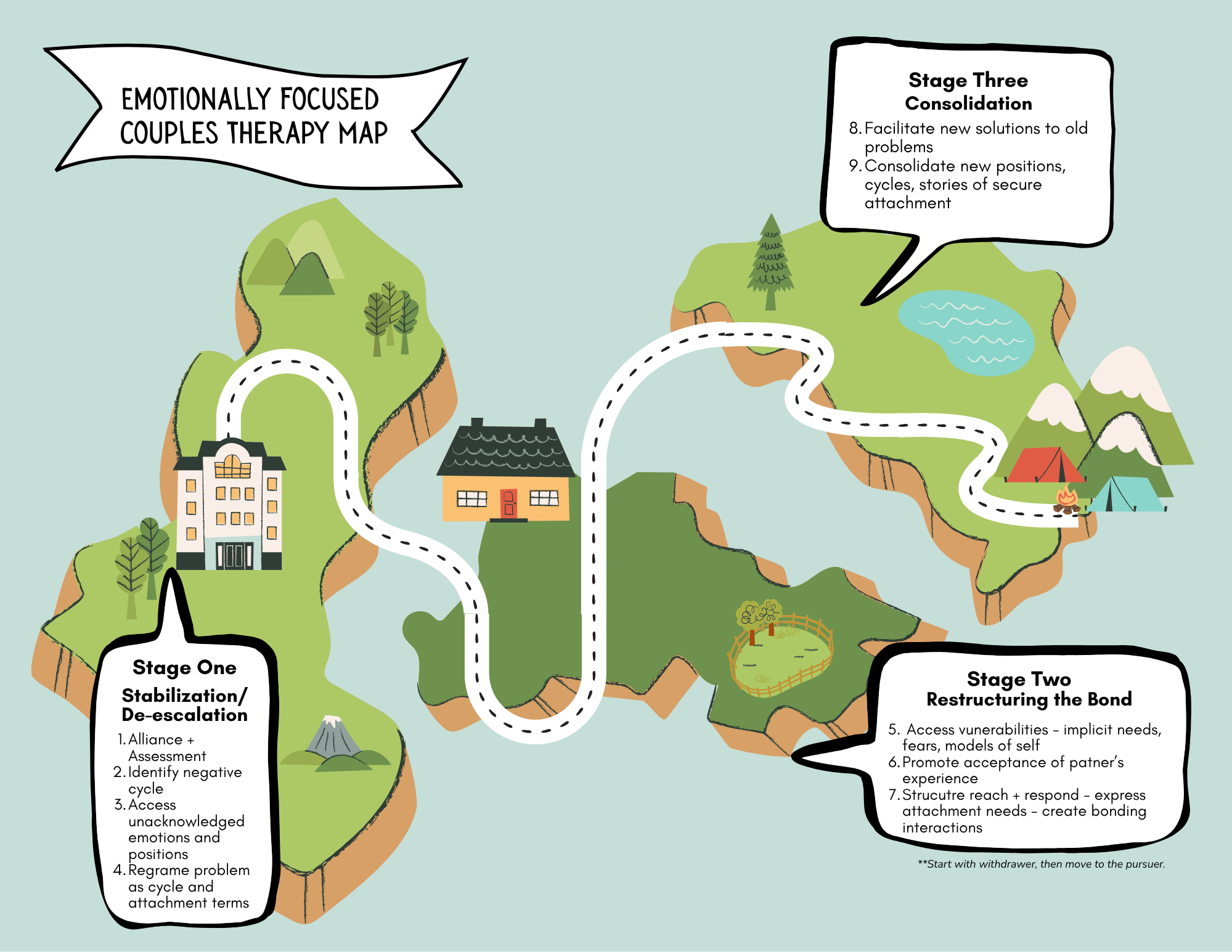
EFT isn’t just about talking through problems—it’s a process that helps create real change in how you experience each other.
This map outlines the general stages of that work:
first understanding the cycle you’re caught in
then accessing and sharing deeper emotions
and eventually creating new, more secure ways of connecting
While every couple’s journey is different, this structure helps guide the process in a way that feels clear and intentional.
EFT for Individuals
Although EFT is best known for couples counseling, I also draw from EFT in individual therapy. This can be especially helpful for people who feel stuck in recurring relationship patterns, anxiety around connection, or a deep sense of being “too much” or “not enough.”
Together, we can gently explore the emotional and relational patterns that developed for good reason—then begin building a steadier, more compassionate way of relating to yourself and others.
You may notice yourself:
feeling anxious, overwhelmed, or constantly “on”
overthinking interactions or second-guessing yourself
being hard on yourself, even when you’re doing your best
feeling like you’re “too much” or “not enough”
wanting connection, but feeling unsure how to fully show up
carrying a lot internally while appearing like you’re managing on the outside
This is often especially meaningful for high-achieving women, anxious overthinkers, and those longing for more secure, grounded relationships.
If this is resonating, you’re welcome to reach out to learn more about working together.
Couples Intensives
Sometimes 50 minutes simply doesn’t feel like enough time. You may find yourselves getting into something important just as the session is coming to an end, or you may want dedicated space to focus more intentionally on your relationship.
Couples therapy intensives offer a longer stretch of time together, allowing us to slow down, stay with what’s happening, and give important conversations more room to unfold.
Extended EFT sessions are available for couples who may benefit from a longer format. We can talk together about whether this might be a good fit for your relationship. Pricing and scheduling details are available upon request.